In a world first event, the Australian Digital Inclusion Alliance (ADIA), the US National Digital Inclusion Alliance (NDIA) and other participating organisations around the globe co-organised International Digital Inclusion Week.

Panellists at IDIW2018

International Digital Inclusion Week ran from 15 – 21 October and aimed to highlight and celebrate digital inclusion efforts around the world. We were thrilled with the variety of events that took place and conversations that were sparked on the #IDIW2018 hashtag.

Highlights included Good Thing Foundation’s Get Online Week – a week long campaign to improve digital ability in Australia and talk about the benefits of getting online. A11y Camp Conference also took place during IDIW2018, bringing together all kinds of web professionals and enthusiasts to devise strategies for a more accessible world.

Our international online panel was also a hit.

With help from a variety of organisations and individuals from who knows how many timezones, the 75-minute panel was brought together to feature the voices of four digital practitioners from different corners of the globe: Kathleen Smeaton, a librarian, educator and researcher who is currently leading the Digital Literacy project at the University of Queensland; Achilles Kameas, Associate Professor of Pervasive Computing Systems with Hellenic Open University, Greece; Munirih Jester, Connecthome Coordinator for the San Antonio Housing Authority and a lead member of the San Antonio Digital Inclusion Alliance, USA, and; Nicola Wallace Dean, Programme Lead for the Starting Point Community Learning Partnership in Stockport, UK.

Our panel discussed how digital inclusion is addressed by their organisations, whether or not digital natives have an advantage over older generations, the role of government and how we measure success.

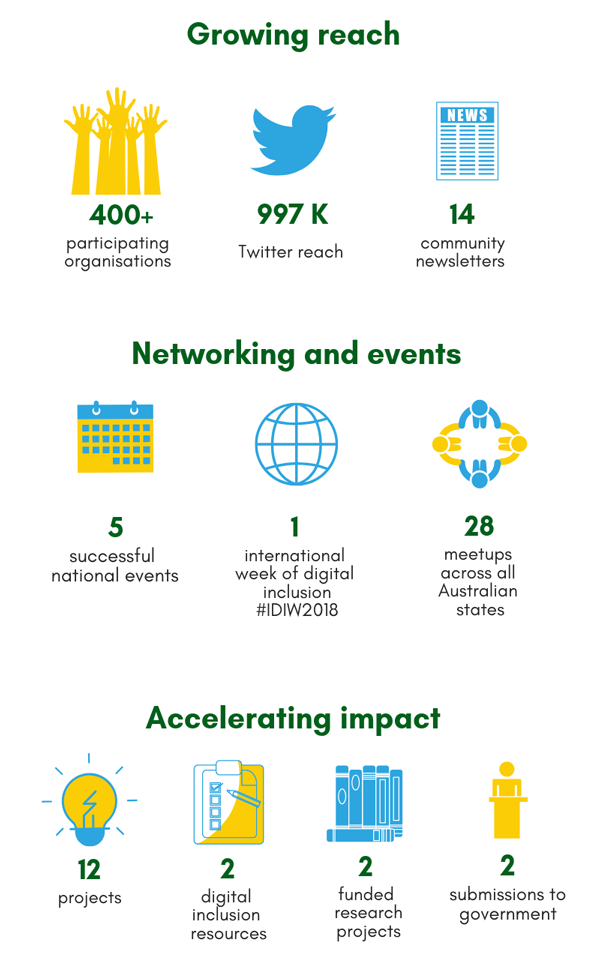
More than 120 people watched the panel in Australia alone, with many joining at meetups in Melbourne, Canberra, Brisbane, Wangaratta and Geelong to participate in the discussion and network locally with other Alliance participants.

Missed out on attending the panel? Not to worry – we recorded it for you. The panel chat and all resources mentioned by the panellists can be found in the YouTube comments section.

We’re glad to have opened the lines of communication and hope to continue collaborating with our international partners. Thanks to our marvellous meetup hosts, attendees and everyone who helped to bring the week together.

Think Digital is an outreach service that builds the digital skills and confidence of regional, rural and remote Australians through the delivery of digital education, experiences and entertainment.

They have hosted over 2,500 workshops across the nation and offer services ranging anywhere from structured learning to the implementation of digital mentorship programs.

“We’re fighting for people who don’t get the same access as their city counterparts,” explains Tim Gentle, founder of Think Digital and ADIA participant. “We’re out there on the frontlines and we feel like we are making a big difference on our own, but now we want to work with others in the space to make an even bigger difference.”

Think Digital is seeking opportunities to work with local government, adult educators and community groups in regional, remote and rural communities to help roll out digital education in their region.

Website: Think Digital

Get in touch: tim@think.digital

Around three million Australians are not participating online and are being left behind in the digital age.

The Australian Digital Inclusion Alliance (ADIA) believes all Australians should be able to make full use of digital technologies and is working together to reduce the digital divide.

More than 100 organisations have come together to accelerate action on digital inclusion with the launch of the Australian Digital Inclusion Alliance (ADIA).

The alliance was established by not-for-profit Infoxchange with support from Australia Post, Google and Telstra.

Today leaders from across the business, academic and community sectors joined to build momentum in addressing the digital inclusion challenges facing Australia.

The launch was also attended by government representatives including Hon Angus Taylor MP, Assistant Minister for Cities and Digital Transformation and Senator Sarah Hanson-Young.

“The ADIA seeks to harness the collective skills, knowledge and capabilities of organisations across the country to reduce the digital divide and enable greater social and economic participation for all Australians”, says David Spriggs, CEO of Infoxchange and Chair of the ADIA.

Infoxchange CEO David Spriggs launches the ADIA.
Infoxchange CEO David Spriggs launches the ADIA. Photo: Anna Kucera

At its heart, digital inclusion is about using online and mobile technologies to improve skills, enhance quality of life, educate, and promote wellbeing across the whole of society.

The Australian Digital Inclusion Index shows that while online participation is increasing across Australia, gaps continue to exist between those who are digitally included and excluded – linked closely to social exclusion and disadvantage.

People with low levels of income, education and employment, along with older Australians, people with disability, remote Indigenous communities and people in regional areas are more likely to be digitally excluded.

Dr Lisa O’Brien, CEO of The Smith Family, says thousands of Australian children don’t have access to technology than many of us take for granted.

“There is a real risk the education gap for these children will increase if this “digital divide” is not well understood or systemically addressed,” says Dr O’Brien.

“The gap doesn’t only relate to access to computers, tablets or phones, but also ability to afford broadband and a lack of digital skills support at home.”

While there are numerous digital inclusion initiatives across the country supported by business, government and community organisations, significant gaps remain.

The ADIA believes digital inclusion needs to be better addressed in public policy and innovative approaches need to be shared. Working groups within the alliance are being established to raise awareness and accelerate collective action in critical areas including affordability, digital ability and accessibility.

Sarah Hanson-Young and Angus Taylor
Left: Senator Sarah Hanson-Young. Right: Hon Angus Taylor MP, Assistant Minister for Cities and Digital Transformation. Photo: Anna Kucera

“Unless we work together with a strategic approach we won’t succeed in achieving an Australia where everyone can participate in the digital world,” says David Spriggs.

Cassandra Goldie, CEO of Australian Council of Social Service (ACOSS), says there are three million people living in poverty in Australia, and around the same number are digitally excluded from Australian life.

“It would be fairly safe to say there is some cross over here, and that giving a necessary hand up and reducing the number of people living in poverty will assist in increasing the accessibility of people to the digital world,” says Ms Goldie.

Find out more about the challenges the ADIA is working to address and get involved by following #digitalinclusionAU on Twitter.